


Syllabus: GS3/Science and Technology
Context
- The Union Budget 2026–27 projects strong ambition in science-led growth, but experts caution that its success depends on effective delivery, timely funding, institutional autonomy, and transparent innovation financing.
About
- In 2023-24, allocation for the Department of Biotechnology was revised down from ₹2,683.86 crore to ₹1,607.32 crore, and actual spending fell further to ₹1,467.34 crore.
- Likewise for the Department of Science and Technology, from ₹7,931.05 crore to ₹4,891.78 crore and actuals of ₹4,002.67 crore.
- Mission-Mode Push in Science: The budget supports major missions like Semiconductor Mission 2.0, CCUS, critical minerals, and biomanufacturing hubs, but concerns remain over long-term, stable financing beyond policy announcements.
R&D Expenditure in India
- India’s Gross Expenditure on Research and Development (GERD) as a percentage of GDP remained between 0.6% to 0.7% which is below the global average and lower than countries like China, South Korea and the US.
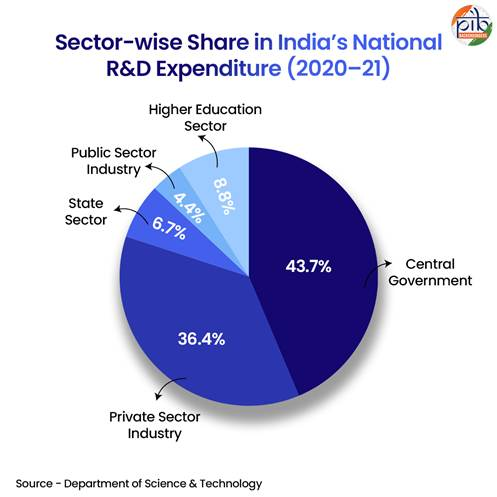
- Another factor contributing to this is the relatively low investment by India’s private sector, accounting for only around 36%, whereas in the aforementioned countries, private sector contributions are more than 70%.
- The Central Government contributes 43.7% of total R&D expenditure.
Need for Funding in R&D
- Economic Growth: Drives new industries, improves productivity, and enhances global competitiveness.
- Technological Advancement: Facilitates breakthroughs in fields like AI, biotechnology, and renewable energy.
- Social Challenges: Helps address poverty, healthcare, education, and environmental sustainability issues.
- Job Creation: Innovation generates employment opportunities and stimulates entrepreneurship.
- Global Positioning: Positions India as a global leader in science, technology, and knowledge.
- Attracts Investment: Promotes foreign and domestic investments in research-driven sectors.
Implications of Low Funding
- Investment Concerns: Limited investment in research and development, especially in public institutions.
- Infrastructure Gaps: Inadequate research facilities and resources in many institutions.
- Brain Drain: Loss of talent to other countries due to better opportunities abroad.
- Lack of Industry Collaboration: Limited partnerships between academia and industry for practical innovation.
- Skill Gaps: Insufficient training and development of skilled researchers and innovators.
Government Initiatives
- Research, Development and Innovation (RDI) Scheme: Approved with a ₹1 lakh crore corpus, this scheme aims to energise private-sector R&D and deep-tech startups.
- It offers long-term, low- or zero-interest loans, equity investments, and funds a new Deep-Tech Fund of Funds via the Anusandhan National Research Foundation (ANRF).
- Anusandhan National Research Foundation (ANRF): The ANRF established in 2023, provides high-level strategic direction for research, innovation, and entrepreneurship in science and technology.
- The Foundation aims to mobilise funds amounting to ₹50,000 crore during 2023–28 through multiple streams, including the ANRF Fund, Innovation Fund, Science and Engineering Research Fund, and Special Purpose Funds.
- National Geospatial Policy, 2022: It seeks to position India as a global leader in the geospatial sector by 2035.
- The policy liberalises access to geospatial data, encouraging its use in governance, business, and research.
- Indian Space Policy, 2023: It builds on the space reforms introduced in 2020, which opened the domain to non-governmental entities for end-to-end participation.
- It aims to enhance space capabilities, promote a flourishing commercial space industry, and foster collaboration between public and private entities.
- National Quantum Mission: Allocated ₹6,003.65 crore for 2023–31, to advance quantum technologies through scientific and industrial R&D.
- BioE3 Policy, 2024: It encourages the creation of Biomanufacturing and Bio-AI hubs, along with a national Biofoundry network, to accelerate technology development and commercialisation.
- National Supercomputing Mission (NSM): Launched in 2015, the initiative empowers universities, research institutions, and government agencies with state-of-the-art supercomputing systems connected through the National Knowledge Network.
- India Semiconductor Mission (ISM): Established in 2021, the mission seeks to build a robust ecosystem for semiconductor and display manufacturing.
- India has already approved 10 semiconductor projects across six states, including the first commercial Silicon Carbide fabrication facility in Odisha.
- India AI Mission: The IndiaAI Mission embodies the vision of “Making AI in India and Making AI Work for India.”
- It is advancing rapidly, having already increased computing capacity from an initial target of 10,000 GPUs to 38,000 GPUs, ensuring accessible AI infrastructure for startups, researchers, and industries.
- Atal Innovation Mission (AIM): To foster innovation at the grassroots level by providing support to students, startups, and entrepreneurs.
- The National Mission on High-Yielding Seeds will focus on strengthening the research ecosystem and developing high-yielding, pest-resistant, and climate-resilient seeds, aligning with DBT’s efforts in agricultural biotechnology.
- The Seaweed Mission and Learn & Earn Program empower women entrepreneurs, supporting economic inclusion.
Way Forward
- To raise R&D spending, there is a need to have increased partnerships with the private sector.
- Efforts are being made to create better synergies between industry, research labs, and educational institutions to broaden both research activity and the funds to support it.
- The Union Finance Minister has also announced several initiatives, including the Nuclear Energy Mission, initiatives in clean tech, Atal Tinkering Labs, and the Centre of Excellence on AI in Education.
Source: TH
Previous article
News In Short 11-02-2026
Next article
Protest Against Ken-Betwa Linking Project
